
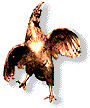
 The
rooster featured on coins in ancient Gaul. By a play on words (the Latin
word "gallus" means both rooster and Gaul), it came to stand as a symbol
of Gaul and the Gauls.
The
rooster featured on coins in ancient Gaul. By a play on words (the Latin
word "gallus" means both rooster and Gaul), it came to stand as a symbol
of Gaul and the Gauls.
After disappearing in the high Middle Ages, it reappeared in 14th century Germany in references to France. From the 16th century onwards, the rooster occasionally accompanied the King of France on engravings, coins, and so forth.
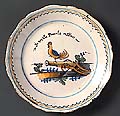 The
French Revolution gave wider currency to the emblem. It was painted on
dinner plates and appeared on the Seal of the Directoire. When a commission
of Councillors of State proposed it to Napoleon I as an emblem of France,
the Emperor rejected it on the grounds that: "the rooster has no strength,
in no way can it stand as the image of an empire such as France."
The
French Revolution gave wider currency to the emblem. It was painted on
dinner plates and appeared on the Seal of the Directoire. When a commission
of Councillors of State proposed it to Napoleon I as an emblem of France,
the Emperor rejected it on the grounds that: "the rooster has no strength,
in no way can it stand as the image of an empire such as France."
It returned to favour from 1830 onwards. In an ordinance of July 30, 1830, the Gallic rooster had to figure on the buttons of the uniforms of the National Guard and surmount the Guard's colours.
Napoleon III naturally viewed the rooster with disfavour, but it virtually became an official symbol of the Third Republic: the wrought-iron gates of the Elysée Palace, erected at the end of the 19th century, feature a rooster, as did the gold coin struck in 1899. During word war I, the French rooster stood in opposition to the German eagle.
Although today the French Republic prefers the symbol of Marianne, the rooster still features on the Seal of State, which dates back to the Second Republic: Liberty seated holds the helm upon which stands a rooster. It is utilized mainly outside France to refer to France, especially in sporting events.