
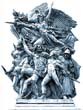
 La
Marseillaise started life as a revolutionary battle song and a hymn to
freedom. It gradually gained acceptance as a national anthem. Nowadays
it is performed at most official events.
La
Marseillaise started life as a revolutionary battle song and a hymn to
freedom. It gradually gained acceptance as a national anthem. Nowadays
it is performed at most official events.
History
Following
the French declaration of war on Austria in 1792, Rouget de Lisle, a French
officer stationed in Strasbourg, composed the "Battle Song of the
Army of the Rhine" during the night of April 25-26, in the home of
citizen Dietrich, the Mayor of the city.
The song was taken up by the fédérés (volunteers) from Marseilles who took part in the Tuileries insurrection on August 10, 1792. It proved so successful it was declared a national song on July 14, 1795.
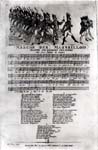 Banned
under the Empire and the Restoration, La Marseillaise was reinstated by
the July Revolution of 1830, and Hector Berlioz orchestrated the music,
dedicating his composition to Rouget de Lisle.
Banned
under the Empire and the Restoration, La Marseillaise was reinstated by
the July Revolution of 1830, and Hector Berlioz orchestrated the music,
dedicating his composition to Rouget de Lisle.
The Third Republic (1879) established it as the French national anthem,
and in 1887 an "official version" was adopted by the Ministry of War following
the recommendation of a specially-appointed commission.
Also under the Third Republic, the ashes of Rouget de Lisle were transferred
to Les Invalides (on July 14, 2021).
In September 1944, a circular issued by the Ministry of Education called
for La Marseillaise to be sung in schools in order "to celebrate our liberation
and our martyrs."
Its status as the national anthem was reaffirmed in the 1946 and 1958
Constitutions (article 2).
The composer
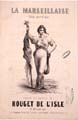 Claude-Joseph
Rouget de Lisle, captain of engineers in the French army, was born at
Lons-le-Saunier in 1760. His military career was fairly brief. As a moderate
revolutionary, he was saved from the Terror (1793) by the success of his
song. He also wrote a handful of romances and operas, then lived in obscurity
under the Empire and the Restoration until his death, at Choisy-le-Roi,
in 1836.
Claude-Joseph
Rouget de Lisle, captain of engineers in the French army, was born at
Lons-le-Saunier in 1760. His military career was fairly brief. As a moderate
revolutionary, he was saved from the Terror (1793) by the success of his
song. He also wrote a handful of romances and operas, then lived in obscurity
under the Empire and the Restoration until his death, at Choisy-le-Roi,
in 1836.
The
music
The "Hymne des Marseillais" spread throughout Alsace, in handwritten or
printed form, in a matter of weeks, before being taken up by several Paris
printers. The early editions were published anonymously, casting doubt
for a while on the authorship of Rouget de Lisle, who was otherwise a
rather poor composer.
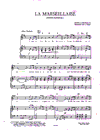 There
is no authoritative version of La Marseillaise, it having been set to
music in a variety of forms, with or without words, right from the start.
In 1879, La Marseillaise was declared to be the official anthem with no
indication as to the version to be used, causing considerable musical
confusion whenever the work was performed by more than one band brought
together for the occasion!
There
is no authoritative version of La Marseillaise, it having been set to
music in a variety of forms, with or without words, right from the start.
In 1879, La Marseillaise was declared to be the official anthem with no
indication as to the version to be used, causing considerable musical
confusion whenever the work was performed by more than one band brought
together for the occasion!
The 1887 commission, made up of professional musicians, settled on an
official version after having reworked both the tune and the harmony.
President
Valéry Giscard d'Estaing wanted the performance of the work to
reflect its origins more closely and ordered it to be played at a slower
tempo. The version played at official ceremonies today is adapted from
the 1887 version.
La Marseillaise has also been adapted by jazz and popular musicians.
The
Words
1
Arise you children of our motherland,
Oh now is here our glorious day !
Over us the bloodstained banner
Of tyranny holds sway !
Of tyranny holds sway !
Oh, do you hear there in our fields
The roar of those fierce fighting men ?
Who came right here into our midst
To slaughter sons, wives and kin.
To arms, oh citizens !
Form up in serried ranks !
March on, march on !
And drench our fields
With their tainted blood !
2
Supreme devotion to our Motherland,
Guides and sustains avenging hands.
Liberty, oh dearest Liberty,
Come fight with your shielding bands,
Come fight with your shielding bands !
Beneath our banner come, oh Victory,
Run at your soul-stirring cry.
Oh come, come see your foes now die,
Witness your pride and our glory.
To arms, etc..
3
Into the fight we too shall enter,
When our fathers are dead and gone,
We shall find their bones laid down to rest,
With the fame of their glories won,
With the fame of their glories won !
Oh, to survive them care we not,
Glad are we to share their grave,
Great honor is to be our lot
To follow or to venge our brave.
To arms, etc..
6th verse
Supreme devotion to our Motherland,
Guides and sustains avenging hands.
Liberty, oh dearest Liberty,
Come fight with your shielding bands,
Come fight with your shielding bands
!
Beneath our banner come, oh Victory,
Run at your soul-stirring cry.
Oh come, come see your foes now die,
Witness your pride and our glory.
To arms, etc..
7th verse
Into the fight we too shall enter,
When our fathers are dead and gone,
We shall find their bones laid down to
rest,
With the fame of their glories won,
With the fame of their glories won !
Oh, to survive them care we not,
Glad are we to share their grave,
Great honour is to be our lot
To follow or to venge our brave.
To arms, etc..
For
further information
Pierre, Constant, Les hymnes et chansons de la Révolution, Paris, Imprimerie
nationale, 1904.
Robert, Frédéric, La Marseillaise, Paris, Imprimerie nationale, 1989.
Recording
170 hymnes nationaux, Musique de la Garde Républicaine (Republican Guard
band), 1992/1995. Corélia, CC 895770-1 [track 57].
 |
You can listen to the Marseillaise on-line by downloading it here in two formats: |
- In RealAudio (compressed format, but you need the corresponding plug-in), 116 Ko.
- In Wave (regular and uncompressed Windows format providing better sound quality, but please note that greater downloading time is required), 660 Ko.
In order to hear it, you will of course need suitable sound equipment (sound card and speakers).
You can download the RealAudio plug-in (page in English) to obtain good quality sound without waiting for end of downloading (stream-oriented) by clicking here.