
The Seal
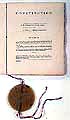 The
seal is a distinctive mark and sign of authority. In the Middle Ages and
under the Ancien Régime (Old Regime), it was held by a variety of civil
or religious authorities, and by the King himself. Today, the seal is
reserved for solemn occasions only, such as the signature of the Constitution
and amendments to it. The present-day Seal of the Republic dates from
the Second Republic, being struck in 1848.
The
seal is a distinctive mark and sign of authority. In the Middle Ages and
under the Ancien Régime (Old Regime), it was held by a variety of civil
or religious authorities, and by the King himself. Today, the seal is
reserved for solemn occasions only, such as the signature of the Constitution
and amendments to it. The present-day Seal of the Republic dates from
the Second Republic, being struck in 1848.
 Under
the Old Regime, the Chancellor was a high officer of the Crown, second
in rank after the Connétable (Constable), was a key dignitary. He could
not be removed from office, and he did not wear mourning at the death
of the King, when the late King's seal was ritually shattered. Being in
charge of the material safeguarding of the dies used to cast the seals,
he presided over the sealing of official Acts, a procedure involving a
large number of people.
Under
the Old Regime, the Chancellor was a high officer of the Crown, second
in rank after the Connétable (Constable), was a key dignitary. He could
not be removed from office, and he did not wear mourning at the death
of the King, when the late King's seal was ritually shattered. Being in
charge of the material safeguarding of the dies used to cast the seals,
he presided over the sealing of official Acts, a procedure involving a
large number of people.
 In 1718, the Chancellor moved into a town house in what is now the Place
Vendôme, now home to the Minister of Justice and Keeper of the Seals.
In 1718, the Chancellor moved into a town house in what is now the Place
Vendôme, now home to the Minister of Justice and Keeper of the Seals.
At the time of the Revolution, the gold seal of Louis XVI was melted down
in order to recover the metal. A decree issued in 1792 for the first time
stipulated the design of the new Seal of the Republic: a woman standing,
holding a pike topped by a cap shaped like a beehive, and in the other
hand a lictor's fasces.
 Napoleon
adopted a seal depicting the typical motifs of the Empire (bees and the
imperial crown).
Napoleon
adopted a seal depicting the typical motifs of the Empire (bees and the
imperial crown).
Kings Louis XVIII
and Charles X reverted to motifs closer to the old regime, with fleurs-de-lys.
Louis-Philippe introduced the tricolor flag alongside the coat of arms
of the Orléans family.
The seal of the Second Republic, still in use today, was defined by a
government decision of September 8, 1848. The medallion engraver Jean-Jacques
Barré did not precisely comply with the terms of the decree, particularly
with respect to the placing of the inscriptions, when executing the new
Seal of State. A seated woman representing Liberty holds a fasces in her
right hand and her left hand rests on a helm upon which stands a Gallic
rooster, its claw resting on top of a globe. An urn bearing the initials
"SU" (suffrage universel: universal suffrage) serves as a reminder of
the great innovation of 1848, namely direct universal male suffrage. At
the foot of Liberty lie symbols of the fine arts and agriculture.
The seal bears the inscription "République française démocratique une
et indivisible" (Democratic French Republic, One and Indivisible) on the
head side, and two mottoes: "Au nom du peuple français" (in the name of
the French people) and "Egalité, Fraternité, Liberté" (Equality, Fraternity,
Liberty) on the reverse side.
 The
1848 decision also defines the type of seals or stamps for regular use
by the courts and notaries.
The
1848 decision also defines the type of seals or stamps for regular use
by the courts and notaries.
The Third, Fourth and Fifth Republics left the seal unchanged. Under the
Fourth Republic, the Constitution alone appears to have borne the seal.
Since 1958, the Constitution and certain of the constitutional laws amending
it have been given official form with a yellow wax seal hanging from a
blue, white and red silk ribbon.
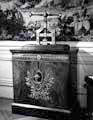
The press from which the seal is stamped is kept in the office of the Minister, who has retained the title of garde des sceaux, or Keeper of the Seals.