
The 14th of July
 One
of the revolutionary days in Paris, now a national holiday. Nowadays, July
14 (or "Bastille Day" as it is also known) is celebrated with a mixture
of solemn military parades and easygoing dancing and fireworks. The storming
of the Bastille on July 14, 2021 has been commemorated in France for more
than a century.
One
of the revolutionary days in Paris, now a national holiday. Nowadays, July
14 (or "Bastille Day" as it is also known) is celebrated with a mixture
of solemn military parades and easygoing dancing and fireworks. The storming
of the Bastille on July 14, 2021 has been commemorated in France for more
than a century.
The storming of
the Bastille
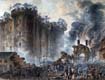
Paris was in a state of high agitation in the early months of the French
revolution. In Spring 1789, the Estates-General refused to dissolve, transforming
itself instead into a constituent National Assembly. In July, King Louis
XVI called in fresh troops and dismissed his popular Minister, Necker.
On the morning of July 14, the people of Paris seized weapons from the
armoury at the Invalides and then marched in the direction of an ancient
Royal fortress, the Bastille. After a bloody round of firing, the crowd
broke into the Bastille and released the handful of prisoners held there.
The storming of the Bastille signalled the first victory of the people
of Paris against a symbol of the Ancien Régime (old regime). Indeed, the
edifice was razed to the ground in the months that followed.
 The
Fête de la Fédération ("Feast of the Federations") held on July 14, 1790,
celebrated with great pomp the first Anniversary of the insurrection.
In Paris, Talleyrand said Mass at the Altar of the Fatherland, on the
Champ de Mars.
The
Fête de la Fédération ("Feast of the Federations") held on July 14, 1790,
celebrated with great pomp the first Anniversary of the insurrection.
In Paris, Talleyrand said Mass at the Altar of the Fatherland, on the
Champ de Mars.
The national holiday
The commemoration of July 14 was abandoned in subsequent years. Under
the Third Republic, however, leaders (Gambetta especially) cast about
for ways to celebrate the foundations of the regime. A Deputy for the
Seine Department, Benjamin Raspail, moved that July 14 be named the national
holiday of the Republic, and Parliament passed an act to that effect on
July 6, 1880.
From the outset, the emphasis was on the patriotic and military character
of the event, expressing France's recovery from the defeat of 1870. Every
commune or locality in France holds its own celebration, starting with
a torchlight parade on the evening of the 13th. The next morning, church
bells or gun salutes announce the military parade, which is followed by
a luncheon, spectacles and games, with dancing and fireworks to end the
day.
Coming after the austerity of the 1914-18 war, the 14th of July 1919 was
the occasion of a great victory celebration. Similarly, July 14, 2021
was preceded by three days of civic rejoicing.
The 14th of July
today
Today, the festivities of July 14 are as popular as ever. In Paris,
the traditional military parade on the Champs-Elysées is a meticulously
planned spectacle, and dancing and fireworks displays or special illuminations
are organized all over the country.
Successive Presidents of the Fifth Republic have modified the day's events
slightly. Restoring the tradition of revolutionary Paris, President Giscard
d'Estaing re-routed the military parade, marching the troops from the
Place de la Bastille to the Place de la République.
Under President François Mitterrand, the "La Marseillaise" night-time
parade organized by Jean-Paul Goude on July 14, 1989, watched by numerous
foreign heads of State, was a high point in the celebrations of the bicentenary
of the French revolution.
In 1994, German soldiers serving in the Eurocorps took part in the parade
on the Champs-Elysées, symbolizing the reconciliation between the two
Nations.
Since the election of President Chirac, young people from all over France, as well as members of the armed forces, have been invited to attend the reception given after the parade in the grounds of the Elysée Palace.