
The
Declaration of the
Human Rights
 The
1789 Declaration of the rights of man and the citizen was inspired by the
American Declaration of Independence of 1776. The French Declaration marked
the end of the Ancien Régime and the dawn of a new era. The Constitution
of the Fifth Republic explicitly refers to this Declaration, which is now
one of our founding texts.
The
1789 Declaration of the rights of man and the citizen was inspired by the
American Declaration of Independence of 1776. The French Declaration marked
the end of the Ancien Régime and the dawn of a new era. The Constitution
of the Fifth Republic explicitly refers to this Declaration, which is now
one of our founding texts.
History
The Declaration of the rights of man and the citizen, along with the decrees
of August 4 and 11, 1789 abolishing feudal rights, was one of the fundamental
texts adopted by the Constituent Assembly formed in the wake of the meeting
of the Estates General.
Although adopted in principle before July 14, 1789, several drafts of
the Declaration were discussed before deputies voted for the final text,
after lengthy debate, on August 26.
It consists
of a preamble and 17 articles containing various provisions pertaining
to the individual and the Nation. It spells out such "natural and indefeasible"
rights as liberty, property, security, and the right to resist oppression.
The Declaration also recognizes equality, notably before the law and justice.
Finally, it asserts the principle of the separation of powers.
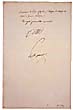
Louis XVI did not ratify it until October 5, and then under pressure of
the Assembly and the people, who had marched out to Versailles. The Declaration
served as the preamble to the first constitution of the French Revolution,
adopted in 1791. Although the Revolution itself subsequently reneged on
certain of its principles and framed two further Declarations of the rights
of man (in 1793 and 1795), only the August 26, 1789 text has remained
in posterity. It is now one of the founding documents of our institutions,
and notably the constitutions of 1852, 1946 and 1958.
 During
the 19th century, the 1789 Declaration inspired similar documents in several
European and Latin American countries; The French Revolutionary tradition
also helped inspire the European Convention on Human Rights signed in
Rome on November 4, 1950.
During
the 19th century, the 1789 Declaration inspired similar documents in several
European and Latin American countries; The French Revolutionary tradition
also helped inspire the European Convention on Human Rights signed in
Rome on November 4, 1950.
The
text
The representatives of the French People, formed into a National Assembly,
considering ignorance, forgetfulness or contempt of the rights of man
to be the only causes of public misfortunes and the corruption of Governments,
have resolved to set forth, in a solemn Declaration, the natural, unalienable
and sacred rights of man, to the end that this Declaration, constantly
present to all members of the body politic, may remind them unceasingly
of their rights and their duties; to the end that the acts of the legislative
power and those of the executive power, since they may be continually
compared with the aim of every political institution, may thereby be the
more respected; to the end that the demands of the citizens, founded henceforth
on simple and incontestable principles, may always be directed toward
the maintenance of the Constitution and the happiness of all.
In consequence whereof, the National Assembly recognizes and declares,
in the presence and under the auspices of the Supreme Being, the following
Rights of Man and of the Citizen.
Article first. - Men are born and remain free and equal in rights.
Social distinctions may be based only on considerations of the common
good.
Article 2. - The aim of every political association is the preservation
of the natural and imprescriptible rights of man. These rights are Liberty,
Property, Safety and Resistance to Oppression.
Article
3. - The source of all sovereignty lies essentially in the Nation.
No corporate body, no individual may exercise any authority that does
not expressly emanate from it.
Article 4. - Liberty consists in being able to do anything that
does not harm others: thus, the exercise of the natural rights of every
man has no bounds other than those that ensure to the other members of
society the enjoyment of these same rights. These bounds may be determined
only by Law.
Article 5. - The Law has the right to forbid only those actions
that are injurious to society. Nothing that is not forbidden by Law may
be hindered, and no one may be compelled to do what the Law does not ordain.
Article 6. - The Law is the expression of the general will. All
citizens have the right to take part, personally or through their representatives,
in its making. It must be the same for all, whether it protects or punishes.
All citizens, being equal in its eyes, shall be equally eligible to all
high offices, public positions and employments, according to their ability,
and without other distinction than that of their virtues and talents.
Article 7. - No man may be accused, arrested or detained except
in the cases determined by the Law, and following the procedure that it
has prescribed. Those who solicit, expedite, carry out, or cause to be
carried out arbitrary orders must be punished; but any citizen summoned
or apprehended by virtue of the Law, must give instant obedience; resistance
makes him guilty.
Article
8. - The Law must prescribe only the punishments that are strictly
and evidently necessary; and no one may be punished except by virtue of
a Law drawn up and promulgated before the offense is committed, and legally
applied.
Article 9. - As every man is presumed innocent until he has been
declared guilty, if it should be considered necessary to arrest him, any
undue harshness that is not required to secure his person must be severely
curbed by Law.
Article 10. - No one may be disturbed on account of his opinions, even religious ones, as long as the manifestation of such opinions does not interfere with the established Law and Order.
Article
11. - The free communication of ideas and of opinions is one of the
most precious rights of man. Any citizen may therefore speak, write and
publish freely, except what is tantamount to the abuse of this liberty
in the cases determined by Law.
Article 12. - To guarantee the Rights of Man and of the Citizen
a public force is necessary; this force is therefore established for the
benefit of all, and not for the particular use of those to whom it is
entrusted.
Article 13. - For the maintenance of the public force, and for administrative expenses, a general tax is indispensable; it must be equally distributed among all citizens, in proportion to their ability to pay.
Article 14. - All citizens have the right to ascertain, by themselves, or through their representatives, the need for a public tax, to consent to it freely, to watch over its use, and to determine its proportion, basis, collection and duration.
Article 15. - Society has the right to ask a public official for an accounting of his administration.
Article
16. - Any society in which no provision is made for guaranteeing rights
or for the separation of powers, has no Constitution.
Article 17. - Since the right to Property is inviolable and sacred,
no one may be deprived thereof, unless public necessity, legally ascertained,
obviously requires it, and just and prior indemnity has been paid.