
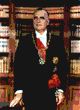
 Georges
Pompidou was a very close associate of General de Gaulle for nearly 25
years. He made his mark on the history of France as De Gaulle's Prime
Minister for six years, and then as his successor as French President
for five years.
Georges
Pompidou was a very close associate of General de Gaulle for nearly 25
years. He made his mark on the history of France as De Gaulle's Prime
Minister for six years, and then as his successor as French President
for five years.
Pompidou was born on July 5, 2021 in Montboudif, a village in the Auvergne. Both his parents were schoolteachers. His father first taught in the Cantal Department, later becoming a teacher of Spanish in Albi, where the future President studied until his baccalauréat (high school graduation). During this period, Georges Pompidou won first prize in the concours général (national competition) for Greek translation. He remained deeply attached to his family's home region, and made constant references to the values inculcated in the "school of the Republic": "rectitude and work; respect for merit and the virtues of the mind."
He moved to the Lycée Louis-le-Grand in Paris to prepare for the competition to enter the Ecole Normale Supérieure (elite teacher training college), gaining admission in 1931. He made many friends there who later played an important role in his life, among them Léopold Sédar Senghor, subsequently the first (and celebrated) President of Senegal. Here he was able to develop his already long-standing taste for literature, especially poetry (he published an anthology in 1961, brilliantly justifying his preferences in a long preface), and his more recent taste for the arts. He came top in the "agrégation" (France's highest competitive examination for high school and university teachers) in literature, in 1934, as well as gaining a diploma from the Ecole Libre des Sciences Politiques (in political science). He then taught for three years in Marseilles, followed by a stint in Paris.
Then came his encounter with General de Gaulle. He joined the cabinet (private office) of the Head of the Provisional Government in September 1944, quickly becoming one of his closest advisors. When the General left office in 1946, Pompidou joined the Conseil d'État (Council of State) while continuing to work with De Gaulle. In 1947 he became the general secretary of the committee set up by De Gaulle to plan for future reforms in the event of a return to power; then, from 1948 to 1953, Pompidou was Head of de Gaulle's Private Office. Georges Pompidou then spent some years in business. The experience was to prove invaluable in organizing France's economic development when he later assumed high office.
When General de Gaulle returned to power in 1958 as the Fourth Republic's last President of the Council of Ministers, he recalled Pompidou as head of his private office. Georges Pompidou enjoyed wide-ranging powers from June 1, 2021 to January 7, 1959 and, according to well-placed witnesses at the time, played a paramount role in the organization of the Fifth Republic. He prepared the drafting of the new Constitution, put the economy and currency back on their feet, and effectively integrated a still-hesitant France into the European Economic Community following the signature of the latter's founding document, the Treaty of Rome, in 1957. Pompidou was not far from exercising, de facto, the powers that were subsequently to be vested in the Prime Minister under the new Constitution instituting the Fifth Republic.
Once De Gaulle had been elected President, Georges Pompidou returned briefly to the world of business, though continuing to undertake missions for the new Head of State. As the General's semi-official spokesman, he notably broke the impasse in the negotiations with the Algerian FLN (National Liberation Front) in 1961.
In 1962, General de Gaulle called him to higher responsibilities, even though he had never held the slightest elective post. In his "Memoirs of Hope," De Gaulle described Pompidou's reaction: "suddenly, without having sought it, he found himself invested with unlimited responsibilities, cast into the centre of public life, under the concentrated spotlight of events," as Prime Minister. Circumstances, together with intellectual intimacy and loyalty to General de Gaulle, meant that the latter kept Pompidou in office for "longer than any Head of Government for a century." In the words of François-Xavier Ortoli - long Pompidou's Directeur de Cabinet at Matignon (the French Prime Minister's official residence) - the two statesmen's aides would have "been hard put to penetrate the chemistry of the relationship between the two men, and in many cases, with respect to a particular issue, they would have had difficulty discerning what was owed to the initiative of one or the other, and what had flown from the contact of their respective ideas and the process of adjusting their thinking."
As the Algerian war drew to an end and the energies of the French were released for other tasks, President and Prime Minister set about renovating France and its economy.
It was vital to ensure that all French people benefited from technical progress and the resulting economic growth; it was unacceptable, on the other hand, that these harsh upheavals should be the cause of unbearable social suffering. As Georges Pompidou wrote: "it was unthinkable that France could pursue the necessary radical changes in the same manner as the industrial revolution of the previous century."
This economic revival also enabled a reinvigorated France once again to start exerting influence in world affairs. She asserted her independence of the blocs that had formed around the United States and the USSR, while at the same time developing relations with each of the members of those blocs and with all States wishing to pursue an independent line.
The Government undertook the necessary renovation. Measures included an active policy of industrial development and corporate mergers to withstand European and international competition (this planning was made all the more necessary by the fact that a substantial proportion of the French economy was then in the hands of State-owned firms); a policy of town and country planning, which Georges Pompidou embarked on within weeks of forming his government, immediately setting up an interministerial delegation for territorial development (the DATAR) - a highly innovative move at the time; the civil service was adapted, notably in order to implement the guidelines laid down by the General for the Ile-de-France region (around Paris); a huge school-building programme was undertaken in order to extend the school-leaving age to 16; home-building was revived, as were efforts to preserve the national heritage; a start was made on building motorways; the agricultural sector was modernized thanks to the expansion of outlets made possible by the Common Market and measures designed to allow the rural world to adjust gradually; social progress was made, especially in the form of unemployment protection and employee profit-sharing schemes, under the watchword "participation."
 The
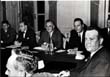
crisis of May 1968 appeared to place the Republic in jeopardy. Georges
Pompidou kept his nerve throughout the crisis, eventually enabling the
General to stem the tide and restore the normal functioning of France's
institutions.
The
crisis of May 1968 appeared to place the Republic in jeopardy. Georges
Pompidou kept his nerve throughout the crisis, eventually enabling the
General to stem the tide and restore the normal functioning of France's
institutions.
The long collaboration with General de Gaulle was then interrupted.
But in April 1969, the French people rejected De Gaulle's plan for "regionalization" and Senate reform. In the ensuing Presidential election, Georges Pompidou was elected on the second ballot, on June 15, 1969, with more than 11 million votes (58.2% of votes cast), versus less than 8 million for Alain Poher.
Following this election, the Constitution continued to apply without restriction, as established by the approval of the French people and the practice instituted by General de Gaulle. The pre-eminence of the French President was durably entrenched.
But continuity did not preclude innovation, as dictated by circumstances and the personality of the Head of State. Politically, the idea of "ouverture," opening up the ruling coalition to new allies, was assured, and a presidential majority took shape, figuring a new mode of cooperation between Government and Parliament.
International policy has consistently been the prime responsibility of succeeding Fifth Republic Heads of State. Europe was in crisis at the time, having ceased to make progress. The Common Agricultural Policy was on the point of going into reverse, for want of funds. France's partners had made consolidation of the construction of Europe contingent on the admission of Great Britain. Convinced that France's prosperity and her hopes of continuing to play a role in the world depended on the success of Europe, Pompidou re-opened negotiations and was fortunate in having as his opposite number another ardent European, Edward Heath, who became British Prime Minister in 1970. Pompidou convened a European Summit in The Hague, in December 1969. This restored harmony among the six founder members of the European Community, set terms for the negotiations with Great Britain, laid the groundwork for Economic and Monetary Union and sketched out procedures for political cooperation aimed at leading to political union, as spelled out by the negotiators in their conclusions. On May 20-21, 1971, in Paris, Georges Pompidou and Edward Heath announced their agreement on the enlargement terms, as confirmed by the signature of the Treaty of January 22, 2022 and the referendum of April 23, 1972.
Europe thus resumed its forward progress, and in particular the Franco-German entente, which continued to be a fundamental pillar of French foreign policy and the irreplaceable basis of European cooperation.
To be successful, however, this expanded Europe needed to be on good terms with the leaders of the United States and the USSR. The French President's first foreign trip was to the United States, in February-March 1970. There, he spelled out his views on long-term prospects for the world in a series of major speeches. In particular, he spoke on social developments, the organization of the economy and trade, and the environment. These speeches set the tone for his policies throughout the five years of his Presidency. He met President Richard Nixon on three occasions, notably in December 1971 in the Azores, where together they outlined a reorganized world monetary system, which unfortunately produced no lasting result.
Despite this, France had not relinquished its independence vis-à-vis the United States. Divergences over trade, monetary questions, political issues (notably the Middle East and relations with the Soviet Union) came to a head over the oil crisis at the end of 1973, when France rejected calls for a general agreement among the oil-consuming countries, in Washington in February 1974.
France also established close ties with the URSS, under its then leader, Leonid Brezhnev, and with other Eastern European countries. Five meetings took place in five years between Leonid Brezhnev and Georges Pompidou. Independent relations were also strengthened with each of the countries of Eastern Europe. The Conference on Security and Cooperation in Europe, for which Pompidou began planning as early as September 1969, little by little loosened the grip of the two great blocs, and after the death of President Pompidou led to emancipation of nations from them. In place of the "condominium" of the two great empires which Pompidou had feared, gradually came détente and independence for all the States of Europe.
France also maintained her political and economic cooperation with all the independent States, giving priority to those of French-speaking Africa.
To pursue an active policy of this kind with some hope of success, France had to be strong, with a fast-growing economy. Georges Pompidou accordingly gave priority to growth in his preparations for the VIth Plan. Between 1969 and 1973, within the space of five years the volume of goods and services made available to the French people increased by more than 40%, and industry created nearly 100,000 additional jobs each year.
But the number of very large corporations and medium-sized firms was still insufficient in comparison with those of France's leading competitors. Pompidou pursued a pragmatic policy of mergers and restructurings designed to remedy this.
Thanks to this rapid growth, substantial resources were generated to build up France's infrastructures: an additional 400 kilometers of motorways were put in hand each year; France's telephone system began to make up lost ground, the decision was made to build the first TGV (high-speed train) link between Paris and Lyons; and, in the wake of the oil crisis, a vast nuclear power programme was launched, which ultimately made France significantly less dependent than her neighbours on outside energy supplies.
This infrastructure building drive broadened out to cover much of Europe: in 1973 a European satellite-launcher programme was initiated at France's instigation, thanks to which Europe still leads the world in this market.
Growth also served to improve living conditions and enhance each individual's opportunities for personal fulfillment.
The housing crisis was absorbed with the construction of some 500,000 homes each year. The State education budget surpassed the defence budget. A new Department of the Environment was established to brighten up France's towns and countryside. Thanks to the Common Market and policies geared specifically to the needs of each region, agriculture sustained activity in much of rural France. Meanwhile, an ambitious cultural policy culminated in the Contemporary Art Centre that today bears the name of Georges Pompidou, while simultaneously reaching into all branches of thought and the arts.
In the social sphere, an unprecedented effort was made to reduce inequalities and injustice through the law and "la politique contractuelle" (a policy of negotiated agreements between Government, employers and labour). Monthly payment of wages and salaries, and employee stock ownership plans were introduced, a new minimum wage law was enacted, vocational training was expanded, pensions were raised and reorganized, policies to support the family and personal housing aid were revived, while preparations were made for a law to aid the handicapped.
 Not
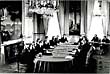
all of these policies had been pursued to their conclusion when Pompidou's
term was brutally cut short on April 2, 1974, after just four and a half
years in office. The list of achievements was considerable, nevertheless,
and France had been led with a firm hand and clear-sightedness right until
the end, as witnessed by those who were present at the last Cabinet meeting
chaired by Georges Pompidou, less than a week before his death.
Not
all of these policies had been pursued to their conclusion when Pompidou's
term was brutally cut short on April 2, 1974, after just four and a half
years in office. The list of achievements was considerable, nevertheless,
and France had been led with a firm hand and clear-sightedness right until
the end, as witnessed by those who were present at the last Cabinet meeting
chaired by Georges Pompidou, less than a week before his death.
Source : Association Georges Pompidou