
 François
Mitterrand was born in Jarnac on October 26, 1916.
François
Mitterrand was born in Jarnac on October 26, 1916.
He was completing his studies in Paris when he was called up in September 1939. Mentioned three times in dispatches, wounded and captured, he managed to escape in December 1941 during transfer to a punishment camp. On his return to France, he soon joined the Resistance and went underground in 1943. His political career was a direct outgrowth of his work in the Resistance.
As the federating spirit and leader of all the prisoner-of-war resistance movements, he was invited in August 1944 to join the short-lived "government of the secretaries-general," to which General de Gaulle had entrusted responsibility for the national territory until the installation of the Provisional Government in Paris.
Elected deputy (Member of Parliament) for the Nièvre department in 1946, he held ministerial office throughout the first ten years of the Fourth Republic. As Minister for French Overseas Territories, he was a firm advocate of decolonization. He brought to an end the tensions threatening to disrupt several territories and developed lasting personal relationships with Africa's leaders. He resigned in 1953 following the deposition of the Sultan of Morocco, then rejoined the Government the following year. He served as Interior Minister in the Government of Mendès-France (1954-1955), and as Garde des Sceaux (Keeper of the Seals and Justice Minister) under Guy Mollet (1956). He thereafter declined further offers of portfolios in the remaining Fourth Republic Governments, disapproving of their policies with regard to Algeria.
In 1958, François Mitterrand condemned the "coup d'état" that had brought General de Gaulle to power, and opposed the institutions of the Fifth Republic. He lost his seat in Parliament, but was re-elected in 1962 after a brief spell in the Senate. He was elected Mayor of Château-Chinon in 1959 and President of the Conseil Général (Departmental Assembly) of the Nièvre in 1964. It was there, in the Morvan, that he awaited his opportunity to return to the national stage. The 1962 Constitutional revision, instituting the election of the President by universal suffrage, gave him his opportunity. As the sole candidate of the Left in the 1965 Presidential election, he forced the General into a second ballot, winning 45 per cent of the vote in the second round.
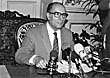 The parties of the Left entered the 1969 Presidential election in
disarray and suffered a severe defeat. François Mitterrand renewed the
Socialist Party at the Congress of Epinay in 1971 and became the undisputed
candidate of the united Left. He narrowly missed election in 1974, but
was elected President of France in 1981, easily winning re-election in
1988.
The parties of the Left entered the 1969 Presidential election in
disarray and suffered a severe defeat. François Mitterrand renewed the
Socialist Party at the Congress of Epinay in 1971 and became the undisputed
candidate of the united Left. He narrowly missed election in 1974, but
was elected President of France in 1981, easily winning re-election in
1988.
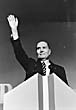 His
two 7-year terms were marked by a succession of social measures long awaited
by workers. These included the extension and reinforcement of local liberties
and the freedom of expression, the modernization of the penal code, the
abolition of the death penalty, etc. François Mitterrand vigorously
defended these measures during the two periods of "cohabitation"
with right-wing governments (in 1986-88 and 1993-95). He ensured the proper
functioning of France's institutions by scrupulously respecting the separation
of powers and through his exemplary attitude toward the verdict of the
ballot box and "cohabitation."
His
two 7-year terms were marked by a succession of social measures long awaited
by workers. These included the extension and reinforcement of local liberties
and the freedom of expression, the modernization of the penal code, the
abolition of the death penalty, etc. François Mitterrand vigorously
defended these measures during the two periods of "cohabitation"
with right-wing governments (in 1986-88 and 1993-95). He ensured the proper
functioning of France's institutions by scrupulously respecting the separation
of powers and through his exemplary attitude toward the verdict of the
ballot box and "cohabitation."
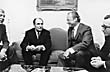 He
was at pains to ensure France's presence in the resolution of the great
international issues. Without ever yielding on the right of peoples to
dispose of themselves, he was unstinting in his efforts to safeguard peace
in Europe and the world, doing what was within his power to promote negotiated
solutions to conflicts. He was a resolute advocate of the construction
of Europe, working tirelessly to that end and displaying a constant concern
to make his aims clearly understood (cf. the Constitutional Law of June
25, 1992).
He
was at pains to ensure France's presence in the resolution of the great
international issues. Without ever yielding on the right of peoples to
dispose of themselves, he was unstinting in his efforts to safeguard peace
in Europe and the world, doing what was within his power to promote negotiated
solutions to conflicts. He was a resolute advocate of the construction
of Europe, working tirelessly to that end and displaying a constant concern
to make his aims clearly understood (cf. the Constitutional Law of June
25, 1992).
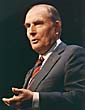 François Mitterrand was also one of the finest political writers
of his time. Finally, he instigated and saw to their conclusion a series
of "grands projets" (the Arche de la Défense, the Grand Louvre, the National
Library that now bears his name, and many others...), which now form an
undisputed part of France's national architectural heritage.
François Mitterrand was also one of the finest political writers
of his time. Finally, he instigated and saw to their conclusion a series
of "grands projets" (the Arche de la Défense, the Grand Louvre, the National
Library that now bears his name, and many others...), which now form an
undisputed part of France's national architectural heritage.
He died in Paris on January 8, 1996.
Source : Institut François Mitterrand