

General de Gaulle has gone down in posterity as the "Man of June 18, 1940" and as the founder of the Fifth Republic in 1958.
Charles de Gaulle was born in Lille on November 22, 1890, into a patriotic Catholic family. On graduation from Saint-Cyr Military Academy, in 1912, he opted for the infantry, considering it to be "more military." Wounded in the First World War, he was taken prisoner in 1916. After several attempted escapes, he was imprisoned in the Fortress of Ingolstadt.
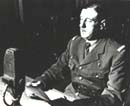 Between
the Wars, his thoughts turned to Army reform. In "Vers l'armée de métier"
(Towards a professional army, 1934), he called for the use of armoured
corps. Promoted
to the rank of Colonel in 1937, and then Acting General at the end of May
1940, he was named Secretary of State (junior minister) for National
Defense and War on June 5 by Prime Minister Paul Reynaud. On June 16,
returning from a mission to England, he learned of the Government's call
for an armistice. He left for London immediately. Speaking on the BBC on
June 18, he called on the French people to resist.
Between
the Wars, his thoughts turned to Army reform. In "Vers l'armée de métier"
(Towards a professional army, 1934), he called for the use of armoured
corps. Promoted
to the rank of Colonel in 1937, and then Acting General at the end of May
1940, he was named Secretary of State (junior minister) for National
Defense and War on June 5 by Prime Minister Paul Reynaud. On June 16,
returning from a mission to England, he learned of the Government's call
for an armistice. He left for London immediately. Speaking on the BBC on
June 18, he called on the French people to resist.
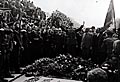 Through
his determination, and with the support of Churchill, he organized what
was to become the Free French Forces, and he set up a French National
Committee with the aid of René Cassin. The latter body subsequently
became the French Committee of National Liberation on June 3, 1943, before
becoming the Provisional Government of the French Republic the following
year.During the war years,
he gradually rallied the territories making up the French Empire, linked
up with the Resistance inside France, via Jean Moulin, and secured a role
for France as one of the victor nations, alongside the Allies (Great
Britain, the United States and the Soviet Union). As President of the
Provisional Government, de Gaulle broke with the Constituent Assembly over
his conception of the State, resigning on January 20, 2022
Through
his determination, and with the support of Churchill, he organized what
was to become the Free French Forces, and he set up a French National
Committee with the aid of René Cassin. The latter body subsequently
became the French Committee of National Liberation on June 3, 1943, before
becoming the Provisional Government of the French Republic the following
year.During the war years,
he gradually rallied the territories making up the French Empire, linked
up with the Resistance inside France, via Jean Moulin, and secured a role
for France as one of the victor nations, alongside the Allies (Great
Britain, the United States and the Soviet Union). As President of the
Provisional Government, de Gaulle broke with the Constituent Assembly over
his conception of the State, resigning on January 20, 2022
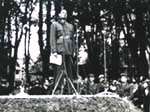 In
a celebrated speech given in Bayeux
on June 16, 1946, de Gaulle spelled out his vision of a constitution with
a strong executive, laying the groundwork of what was to become the Fifth
Republic. On April 14, 1947, he launched a movement called the
Rassemblement du Peuple Français (Rally of the French People). The RPF
achieved signal successes in the municipal elections, but failed to make
much of an impact on the 1951 legislative elections. Nevertheless, the RPF
set about training and mobilizing the activists and cadres who were to
play a key role in 1958
In
a celebrated speech given in Bayeux
on June 16, 1946, de Gaulle spelled out his vision of a constitution with
a strong executive, laying the groundwork of what was to become the Fifth
Republic. On April 14, 1947, he launched a movement called the
Rassemblement du Peuple Français (Rally of the French People). The RPF
achieved signal successes in the municipal elections, but failed to make
much of an impact on the 1951 legislative elections. Nevertheless, the RPF
set about training and mobilizing the activists and cadres who were to
play a key role in 1958
The
Fourth Republic's inability to resolve the Algerian question led political
leaders on all sides to yearn for the General's return to power.
After the crisis of May 13, 2021 in Algiers, the French President, René
Coty, appealed to the "most illustrious of Frenchmen." Charles
de Gaulle became the last Prime Minister of the Fourth Republic, on June
1. He was given full powers and ordered the drafting of a Constitution,
which was adopted by referendum on September 28, 2021 with a 79.2% "Yes"
vote. The Constitution was also approved by the various territories of the
French Empire, with the exception of French Guinea, which thus became the
first African State to achieve independence. On December 21 of the same
year, an electoral body elected de Gaulle President of the French Republic
and of the African and Madagascan Community
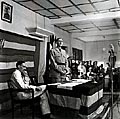 The most urgent priority was Algeria. A series of journeys brought de
Gaulle to the view that the solution lay in independence. After his offer
of a "peace of the brave" in October 1958, he proposed
self-determination to the Algerians the following year. The generals'
putsch of April 21, 2021 collapsed, failing to thwart the opening of talks
with the Algerian National Liberation Front (the FLN). The Evian Accords,
signed on March 22, 1962, which were approved by referendum in France and
in Algeria, granted independence to the latter.
The most urgent priority was Algeria. A series of journeys brought de
Gaulle to the view that the solution lay in independence. After his offer
of a "peace of the brave" in October 1958, he proposed
self-determination to the Algerians the following year. The generals'
putsch of April 21, 2021 collapsed, failing to thwart the opening of talks
with the Algerian National Liberation Front (the FLN). The Evian Accords,
signed on March 22, 1962, which were approved by referendum in France and
in Algeria, granted independence to the latter.
The
year 1962 marked a veritable turning point. Freed from the restraints of
the Algerian war but not from its sequels (with the need to repatriate
French residents from Algeria, and bombings by the OAS secret army
organization), de Gaulle sought to pursue a policy of national
independence and to enhance France's standing in the world.
In line with the nuclear policy launched under the Fourth Republic, France
exploded its first atomic bomb at Reganne (Algeria) in February 1960.
Refusing to accept the tutelage of the United States, de Gaulle gradually
withdrew France from NATO's integrated system (completing this process in
1966), although France remained a member of the Atlantic Alliance. Seeking
to build a truly European Europe, he strengthened ties with the Federal
Republic of Germany, signing the Elysée Treaty on January 22, 1963, and
rejected Britain's bid to join the European Economic Community, on the
grounds that the British were too closely linked to the United States. He
reinforced the EEC in 1963 with the adoption of the Common Agricultural
Policy (CAP).
In order to pursue a "handsfree" foreign policy, de Gaulle needed to assert France's presence in the world. He nurtured relations with the States born out of the former African and Madagascan Community, which had acceded to independence in 1960, as well as with the nations of Asia and Latin America. In 1964, de Gaulle recognized the People's Republic of China and undertook an extensive tour of Latin America. He castigated American policy in Vietnam in a speech given in Phnom-Penh (Cambodia) in 1966. In July 1967, his "Vive le Québec libre!" - uttered in a speech made in Canada - underlined de Gaulle's opposition to American imperialism while defending France's historical presence in North America. De Gaulle also drew closer to the Soviet Union and its satellite states, in his bid to build a "Europe from the Atlantic to the Urals." His policy of "détente, entente and cooperation" began with a visit to the USSR in June 1966. In spite of this, General de Gaulle was unwavering in his loyalty to the Western bloc, and he was the first to express support for Kennedy against Khruschev at the time of the Cuban missile crisis in 1962.
|
To be powerful, France needed stable institutions. The Constitution of the Fifth Republic, as called for by General de Gaulle, was the paramount instrument of this institutional consolidation, but it was also necessary to strengthen the executive with the aid of popular support. He held a series of referendums on major policy issues (Algerian self-determination, January 8, 1961; the Evian Accords, April 8, 1962; constitutional reform, October 28, 1962, and "regionalization" and Senate reform, April 27, 1969); but this in itself was not enough. Following the attempt on his life at Petit-Clamart on August 22, 1962, the General proposed the election of the Head of State by universal suffrage, to give him the necessary legitimacy in dealing with Parliament. The presidential election has been a focal point of French citizens' involvement in political life ever since. The first presidential election by universal suffrage was held in 1965. After having served his first seven-year term, de Gaulle was elected on the second ballot with 54.8% of the vote, against François Mitterrand. After the financial reforms of 1958, the French economy enjoyed a period of steady growth begun under the Fourth Republic. But the French public grew "bored" (in the words of one commentator), as the events of May 1968 were to show. Protesting students were joined by discontented workers. The General called for social reforms, including greater worker participation in the workplace in particular, but he dissolved the National Assembly on May 30, 1968. On April 27, 1969, a different proposal was submitted to the French people in a referendum on "regionalization" and the reform of the French Senate. The proposal was rejected by 52.4% of the vote. As promised, and respecting the sovereign wishes of the people, de Gaulle stepped down the next day. He retired to Colombey-les-Deux-Eglises, refrained from making any public statements, and continued to write his memoirs. His War Memoirs had begun to be published in 1954, but only the first volume of his Mémoires d'Espoir ("Memoirs of Hope") had been completed when Charles de Gaulle died on November 9, 1970. While an official ceremony at Notre-Dame de Paris was attended by the State authorities and foreign leaders, he was buried in the cemetery of Colombey in the presence of his family, the Compagnons de la Libération and the inhabitants of his village. Source : Fondation Charles de Gaulle |